Fillomino Logic Puzzles: A Practical Guide to Getting the Most from This Addictive Number-Filling Challenge
If you have spent any time browsing puzzle books or digital downloads, you have likely encountered Fillomino logic puzzles. At first glance, they resemble a cross between Sudoku and a jigsaw, but they operate on their own unique logic. The premise is simple: fill a grid with numbers so that each region contains the same number of cells as the number it holds, and regions of the same number never touch orthogonally. Yet despite that straightforward rule, many people—beginners and experienced solvers alike—make avoidable mistakes that drain time, cause frustration, or lead to poor purchases. This article walks through the most common pitfalls and shows you how to approach Fillomino logic puzzles with confidence, whether you are solving for fun, teaching others, or creating puzzle books for sale.
What Exactly Are Fillomino Logic Puzzles and Why Do They Deserve Your Attention?
Fillomino logic puzzles belong to the family of deductive reasoning games that require pattern recognition, systematic elimination, and careful planning. Unlike some puzzles that rely on arithmetic or vocabulary, Fillomino asks you to partition the grid into polyomino regions—connected groups of cells—where each region's size matches the number written inside it. A region with a "3" must contain exactly three contiguous cells, all labeled with 3s. Two regions that share the same number cannot touch along an edge, though they may meet diagonally.
What makes Fillomino especially rewarding is its visual and spatial nature. You are not just crunching numbers; you are building shapes, expanding territories, and constantly verifying that your placements do not violate adjacency rules. This combination of logic and geometry provides a mental workout that sharpens concentration, improves problem-solving stamina, and offers a satisfying sense of progress as the grid fills in. For adults aged 20 to 50—whether you are a busy professional looking for a short mental reset, an educator seeking classroom material, or a creator assembling puzzle books—Fillomino is a versatile and underappreciated tool.
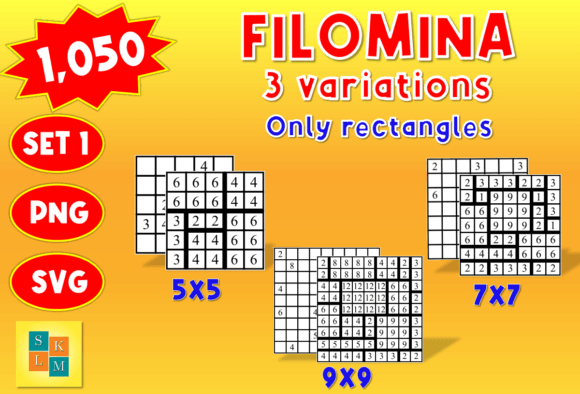
A typical collection might include 1,050 puzzles across three grid sizes—5x5, 7x7, and 9x9—with four difficulty levels that gradually introduce more complex partitioning challenges. The 5x5 grids are ideal for learning the mechanics, while the 9x9 versions demand sustained attention and careful deduction. When you understand what each size demands and how difficulty scales, you can choose the right set for your needs and avoid the common mistakes that follow.
Mistake #1: Choosing the Wrong Grid Size for Your Actual Goal
One of the most frequent errors people make with Fillomino logic puzzles is selecting a grid size that does not match their purpose. If you are new to the puzzle type, jumping straight to 9x9 puzzles can be overwhelming. The larger grid introduces more regions, more potential adjacency conflicts, and a significantly longer solve time. Conversely, experienced solvers sometimes dismiss 5x5 puzzles as too easy, not realizing that small grids can still offer elegant challenges when the difficulty level is turned up.
The better approach is to match grid size to your objective. For personal entertainment or a quick daily brain warm-up, 5x5 or 7x7 puzzles provide a manageable time commitment—often 5 to 15 minutes each. For educators or parents introducing logic puzzles to students, the 5x3 and 5x5 sizes are excellent starting points because they allow learners to grasp the core rule about region size and adjacency without frustration. For creators assembling puzzle books intended for a general audience, a mix of sizes is essential. A book that contains only 9x9 puzzles may alienate beginners, while a book with only 5x5 puzzles may feel too brief for dedicated solvers. A well-rounded collection includes all three sizes, each with varied difficulty, so users can progress naturally.
Before you download or purchase any Fillomino logic puzzle set, ask yourself: Who will be solving these? How much time do they have per session? What skill level are they starting from? Answering those questions first will save you from wasting money on a collection that sits unused.
Mistake #2: Overlooking the Importance of Puzzle Quality and File Format
Another common oversight involves assuming all Fillomino logic puzzles are created equal. They are not. A poorly constructed puzzle can have multiple valid solutions, ambiguous clue placements, or regions that are impossible to fill without guesswork. This undermines the entire point of a logic puzzle, which should be solvable through deduction alone.
When evaluating a puzzle set, look for evidence that the puzzles have been computer-checked or manually verified for uniqueness. Reputable collections typically state that each puzzle has exactly one solution and that the difficulty levels have been calibrated by testing. If you are purchasing a digital download, check whether the files are provided in scalable vector formats such as SVG and PNG. SVG files allow you to resize puzzles without losing clarity—critical if you plan to print them in a book, display them on a screen, or convert them to other formats. PNG files at high resolution also work well for immediate printing, but avoid low-resolution images that become pixelated when enlarged.
The listing you evaluate should include a clear description of what you receive. A high-quality Fillomino set will specify the number of puzzles per size, the difficulty progression, and the file formats. For example, a set that provides 350 easy puzzles in 5x3 or 5x5 format, plus 350 medium in 7x7, plus 350 hard in 9x9, all in both SVG and PNG, gives you flexibility to print, edit, or repurpose the content. If the listing is vague about file types or solution verification, consider that a warning sign.
Mistake #3: Ignoring the Solution Files and How They Are Designed
It may sound obvious, but solution files matter more than many people realize. Some puzzle collections bury the solutions in a separate document with tiny print, or worse, omit them entirely. If you are using Fillomino logic puzzles for self-study, you need to verify your reasoning when you get stuck. A good solution file does not just show the final filled grid—it shows the completed regions clearly, often with shading or bold outlines, so you can see exactly which cells belong to which polyomino.
For creators and educators, solution files are essential for quality control. When you include them in a puzzle book, you must ensure they are accurate, easy to read, and correctly indexed to each puzzle. A mismatch between puzzle numbers and solution pages creates confusion and erodes trust. Before committing to a large set, spot-check a handful of puzzles. Solve a few yourself and compare your results to the provided solutions. If discrepancies appear, the entire set may be unreliable.
Mistake #4: Underestimating the Learning Curve and Not Using Available Guidance
Many adults, especially those who are comfortable with Sudoku or crossword puzzles, assume they can jump into Fillomino logic puzzles without any introduction. While the rules are simple, the deduction techniques take practice. Common early errors include placing numbers that create orphan cells—single empty squares that cannot be reached by any region of the correct size—or inadvertently allowing two regions of the same number to touch diagonally but interpreting the adjacency rule incorrectly.
A wise approach is to review a "how to play" guide before starting. Good collections include clear instructions and sometimes a walkthrough of a sample puzzle. If the set you are considering does not include notes or a tutorial, find one online before you begin. Understanding the technique of "forced placement"—where only one possible shape fits a given clue—and the method of "elimination by adjacency" will save you hours of trial and error. For educators and creators, including a concise rules page and a solved example in your puzzle book dramatically improves the user experience and reduces support requests.
Mistake #5: Rushing to Publish or Print Without Testing the Workflow
For small business owners, bloggers, and freelancers who plan to assemble Fillomino puzzle books, a critical mistake is rushing the production process. You have the puzzle files, the solutions, and the formatting tools—but if you do not test your workflow, you may end up with misaligned grids, missing numbers, or inconsistent margins that make the puzzles unusable.
Before you commit to a large print run or a digital release, create a single test book with a few puzzles. Print it at the expected size, check that the SVG files have rendered correctly in your layout software, and verify that the grid lines are crisp and the numbers are legible. The recommended tools often include vector editing software like Adobe Illustrator, Inkscape, or Affinity Publisher, as well as book formatting platforms such as Canva or Amazon KDP. Test every step—import, resize, export, print—so you catch issues early. A small time investment in testing can prevent a costly mistake that affects your reputation.
What to Check Before You Buy or Download a Fillomino Puzzle Set
Whether you are a consumer or a creator, here is a practical checklist to use before you commit to any Fillomino puzzle collection:
- Puzzle count and size distribution. Are the puzzles evenly distributed across 5x5, 7x7, and 9x9 grids? Do the difficulty levels match your audience or personal skill level?
- Solution accuracy. Is each solution clearly presented and verified? Can you quickly cross-reference puzzles with their solutions?
- File formats. Are SVG and PNG files included? SVG ensures scalability, while PNG provides quick printing options.
- Instructional content. Is there a clear rules page or tutorial? This is especially important if you are new to Fillomino or if you plan to share the puzzles with others.
- Licensing and usage rights. If you intend to use the puzzles in a commercial product, confirm that the license permits that use. Some puzzle sets are for personal use only.
- Tool recommendations. Does the set include advice on which software or platforms work best for editing and assembling the puzzles? This can save you hours of trial and error.
Taking five minutes to evaluate these points can mean the difference between a satisfying purchase and a regrettable one.
Practical Advice for Getting the Most Out of Your Fillomino Experience
If you are solving for personal enjoyment, start with the 5x5 grids at the easy level. Work through a dozen puzzles until the logic becomes intuitive—you should start to see where a region can and cannot go without manually checking every option. Then move to the 7x7 medium puzzles, and finally tackle the 9x9 hard puzzles. This progression builds your mental toolkit step by step.
If you are an educator, use the small puzzles as a five-minute warm-up exercise. The spatial reasoning required in Fillomino logic puzzles complements logical thinking in math, computer science, and even language arts. Encourage students to verbalize their reasoning: "I placed the 4 here because if it went one cell to the left, it would block the 3 region." That verbalization reinforces deductive discipline.
If you are a creator or entrepreneur assembling a puzzle book, invest time in the layout. Use consistent fonts, clear grid lines, and adequate spacing. Include a brief introduction that explains the rules and gives an example. Organize puzzles by size and difficulty, and ensure the solutions are grouped logically at the back with clear references. Your readers will appreciate the thoughtfulness, and they will return for future volumes.
Why Fillomino Logic Puzzles Deserve a Place in Your Routine or Portfolio
Fillomino offers a distinct blend of logic, spatial reasoning, and quiet satisfaction. Unlike puzzles that rely on external knowledge or vocabulary, Fillomino is entirely self-contained—the clues are all on the grid, and the rules are few. This purity makes it accessible to anyone, regardless of background. At the same time, the puzzles can be deeply challenging, rewarding careful thought and patience.
For adults balancing busy lives, a single 5x5 Fillomino puzzle can serve as a focused break that resets your attention. For professionals and creators, a well-organized puzzle collection is a product that appeals to a growing audience seeking screen-free mental engagement. By avoiding the common mistakes outlined here—choosing the wrong size, overlooking file quality, ignoring solution files, skipping the learning curve, and rushing production—you set yourself up for success, whether you solve for pleasure or produce for profit.