Dominosa Logic Puzzle: A Complete Guide to the Classic Deduction Game
If you enjoy puzzles that reward patient reasoning and clear thinking, the Dominosa logic puzzle offers a satisfying challenge that sits somewhere between a Sudoku grid and a set of dominoes. At its core, Dominosa asks you to place numbered domino pieces onto a grid so that every possible pair appears exactly once. The result is a clean, logical puzzle that exercises your brain in ways that feel productive rather than repetitive. Whether you are an educator looking for classroom material, a publisher building a puzzle collection, or a professional who values mental sharpness during breaks, this game has something to offer across a range of difficulty levels and grid sizes.
What Is a Dominosa Logic Puzzle?
A Dominosa logic puzzle presents you with a grid of numbers. Your task is to divide that grid into domino-shaped rectangles, each containing two adjacent cells, such that every possible pair of numbers (from 0–0 up to the highest number in the set) appears exactly once. For example, in a standard 0–6 set, there are 28 unique domino pairs, and the grid must accommodate all of them without overlap or gaps. The puzzle is a pure exercise in deductive reasoning: you begin with no clues beyond the numbers themselves, and you must systematically eliminate possibilities until the only arrangement that fits all constraints remains.
What makes Dominosa especially engaging is how the same set of rules can produce puzzles of vastly different complexity depending on the grid dimensions. Small grids like 5×4 introduce you to the mechanics with fewer dominoes, while larger grids such as 11×10 demand sustained concentration and methodical elimination. This scalability means you can return to Dominosa again and again, each time facing a fresh challenge that respects your growing skill.
Why These Puzzles Matter for Your Mental Toolkit
Logic puzzles like Dominosa are not just pastimes—they are structured exercises in critical thinking. Every move you make requires you to hold multiple constraints in mind: which domino pairs remain, which cells are already claimed, and which placements would force an impossible situation later. This kind of active reasoning strengthens your ability to manage complexity in real-world tasks, from project planning to data analysis.
For professionals who spend hours making decisions under uncertainty, the habit of methodical elimination that Dominosa cultivates can transfer directly to work. You learn to recognise when a solution is forced, when you need to test a hypothesis, and when to backtrack and reconsider assumptions. These are not abstract skills; they are the building blocks of effective problem solving in any field.
Moreover, the satisfaction of completing a puzzle—especially a larger one—provides a genuine sense of accomplishment. In a world of endless notifications and fragmented attention, finishing a Dominosa grid offers a rare moment of complete focus and closure.
Seven Grid Variations for Progressive Challenge
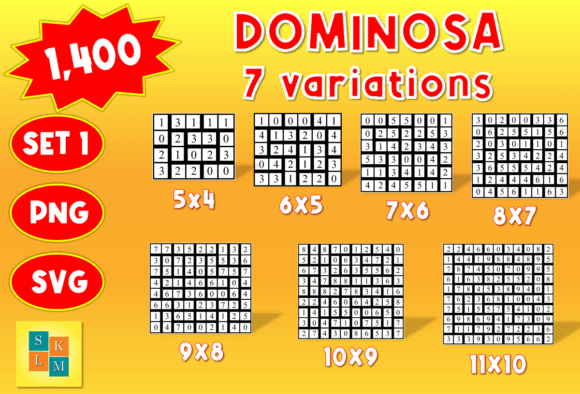
The collection described here includes 200 puzzles for each of seven grid sizes: 5×4, 6×5, 7×6, 8×7, 9×8, 10×9, and 11×10. That totals 1,400 puzzles, each with its own solution file. The progression is deliberate. Smaller grids contain fewer dominoes and fewer possible pairings, making them ideal for learning the logic and building confidence. As the grid grows, so does the number of variables you must track simultaneously, which naturally increases the difficulty without changing the rules.
- 5×4 and 6×5 grids are excellent starting points. They complete quickly and let you internalise the pattern-matching and elimination process.
- 7×6 and 8×7 grids introduce a moderate challenge. You will need to consider multiple branches and keep track of remaining dominoes more carefully.
- 9×8, 10×9, and 11×10 grids demand sustained focus. These larger puzzles reward systematic approaches and patience, making them ideal for experienced solvers or extended sessions.
Having all seven sizes in one collection means you can match your puzzle choice to your available time and mental energy. A 5×4 puzzle works well during a short coffee break, while an 11×10 might be saved for a quiet weekend afternoon.
Who Benefits Most from Dominosa Puzzles
While anyone can enjoy a logic puzzle, certain groups may find Dominosa particularly useful. Educators and tutors can use these puzzles to teach deductive reasoning, pattern recognition, and systematic thinking in a concrete, hands-on way. The visual grid and tile layout make the logic visible, which helps students grasp abstract concepts more easily than with word problems alone.
Publishers and content creators looking for reproducible puzzle content will appreciate that each puzzle comes in both SVG and PNG formats, with solutions included. This makes it straightforward to incorporate Dominosa into books, worksheets, apps, or newsletters without needing to generate puzzles from scratch. The attached notes on how to play and recommended tools for creating or editing puzzles add further practical value.
For professionals who spend much of their day in analytical roles—marketers reviewing data, entrepreneurs weighing options, developers debugging code—a short Dominosa session can serve as a mental reset. The puzzle demands a different kind of focus than typical work tasks, which can help reduce fatigue and improve cognitive flexibility when you return to your primary responsibilities.
Hobbyists and lifelong learners who simply enjoy the satisfaction of solving will find the range of sizes keeps the experience fresh. Having 1,400 puzzles means you are unlikely to exhaust the collection quickly, and the progression from small to large allows you to track your own improvement over time.
Practical Benefits of Deductive Reasoning Practice
Regular engagement with deduction puzzles like Dominosa offers benefits that extend beyond the puzzle itself. One of the most cited advantages is improved pattern recognition. When you scan a grid for possible domino placements, you are training your brain to see relationships and constraints quickly—a skill that applies to reading a spreadsheet, interpreting a dashboard, or even navigating a complex schedule.
Another benefit is increased comfort with systematic elimination. In Dominosa, you cannot guess your way to a solution. Every placement must be logically justified, and wrong choices become apparent only through careful backtracking. This process builds a tolerance for ambiguity and a methodical approach to troubleshooting that is valuable in any technical or managerial role.
There is also a less obvious benefit: improved working memory. Holding the list of remaining domino pairs in your head while visually scanning the grid requires active short-term memory use. Over time, this can help you maintain focus during complex tasks and reduce the mental effort needed to juggle multiple pieces of information at once.
Realistic Use Cases
Consider a marketing professional sifting through campaign data. The habit of eliminating variables one by one—testing a channel, ruling out a demographic, confirming a trend—mirrors the logic of solving a Dominosa puzzle. The puzzle does not replace the work, but it reinforces a mindset that makes the work feel more natural.
For a small business owner evaluating different product bundles, the same elimination logic applies: given a set of constraints (cost, demand, inventory), you must find the arrangement that satisfies all conditions. Practicing Dominosa does not give you business answers, but it trains the mental muscle you use to find them.
Even for a blogger or writer, the puzzle offers a structured break that can reduce mental blocks. A focused 15-minute session on a 6×5 grid can reset your attention and help you return to writing with a clearer mind.
What Is Included in This Collection
This listing provides a complete puzzle resource: 200 puzzles for each of the seven grid sizes, plus solution files for every puzzle. All files are delivered as SVG and PNG images inside a zip archive. The SVG format is especially useful if you want to resize, edit, or import the puzzles into another document or layout tool. PNG files work well for quick display or printing without additional software.
The collection also includes attached notes explaining how to play Dominosa and listing recommended tools you can use to create or customise your own puzzles. This makes the pack suitable not only for solving but also for learning the underlying logic or even designing new puzzles as a teaching or publishing exercise.
File Breakdown
- 5×4 Dominosa: 200 puzzles and solutions (SVG + PNG)
- 6×5 Dominosa: 200 puzzles and solutions (SVG + PNG)
- 7×6 Dominosa: 200 puzzles and solutions (SVG + PNG)
- 8×7 Dominosa: 200 puzzles and solutions (SVG + PNG)
- 9×8 Dominosa: 200 puzzles and solutions (SVG + PNG)
- 10×9 Dominosa: 200 puzzles and solutions (SVG + PNG)
- 11×10 Dominosa: 200 puzzles and solutions (SVG + PNG)
- Notes on how to play and recommended tools for puzzle creation
Having solutions alongside the puzzles is a practical advantage. If you get stuck, you can check your reasoning or learn a different solving strategy by comparing your approach to the solution. For educators, solutions make it easy to verify student work without solving every puzzle yourself.
Limitations and Fit Considerations
No puzzle is perfect for everyone, and Dominosa has a few characteristics worth noting. First, the game requires comfort with numbers and sequences. If you or your audience prefer purely visual or word-based puzzles, Dominosa may feel too mathematical. However, the arithmetic involved is minimal—you only need to recognise pairs and count remaining dominoes, not perform calculations.
Second, the larger grids (10×9 and 11×10) can take 30 to 60 minutes to solve, depending on your experience. If you are looking for quick warm-ups, you will want to stick with the 5×4 or 6×5 sizes. The collection accommodates this by offering all sizes, so you can choose accordingly.
Third, while the provided SVG and PNG files are ready to use, you may need basic image or document editing software to incorporate them into a custom layout. The included notes recommend tools, but you should check that your workflow supports these formats before purchasing. For most users, PNG files will work immediately for printing or digital display.
Finally, because Dominosa relies solely on logic without any random element, some solvers may eventually find the pattern familiar. Having 1,400 puzzles across seven sizes delays this repetition considerably, but if you solve puzzles at a very high volume, you might eventually wish for additional variations or larger grids.
Thoughts on Getting Started
If you are new to Dominosa, start with the 5×4 grid. Open one puzzle and a solution file side by side. Try to place the first few dominoes by looking for forced pairs—cells where only one possible match exists. As you gain confidence, you will learn to spot patterns like isolated numbers or unique remaining pairs that can only fit in one location. The notes included with the collection explain these techniques clearly.
For those who already enjoy puzzles like Sudoku or Kakuro, Dominosa will feel familiar in its reliance on deduction but fresh in its domino-based mechanics. The grid sizes in this collection allow you to scale up gradually, which is a better learning path than jumping straight to the largest puzzles.
If you are a publisher or educator, consider using the smaller grids as introductory material and the larger ones as advanced challenges. The variety of sizes means you can offer puzzles that match different skill levels within the same collection, which is valuable for differentiated instruction or multi-level puzzle books.
Final Observations
Dominosa logic puzzles occupy a sweet spot in the world of deductive games. They are simple enough to learn in five minutes, yet deep enough to reward hundreds of hours of practice. The structured elimination, pattern recognition, and constraint management they demand are not just entertaining—they reinforce skills that carry over into analytical work, decision making, and creative problem solving.
This particular collection, with 1,400 puzzles across seven grid sizes and complete solution files in SVG and PNG formats, gives you a substantial resource whether you plan to solve them yourself, use them in teaching, or republish them in some form. The included notes on gameplay and recommended tools reduce the learning curve so you can start solving almost immediately.
If you value puzzles that respect your intelligence, reward careful thinking, and offer genuine variety, Dominosa is worth exploring. The progression from small to large allows you to enter at a comfortable level and grow at your own pace—and with 200 puzzles at each size, you will have plenty of opportunities to do exactly that.