The Complete Guide to Mileage Logbooks for Truckers: Stay Organized, Compliant, and Profitable
For every professional trucker, the open road represents freedom, purpose, and livelihood. But behind the romance of long-haul journeys lies a demanding reality: meticulous record-keeping. Among the most essential tools in a driver’s cab is the mileage logbook. Whether you are an owner-operator, a company driver, or a fleet manager, understanding how to use a mileage logbook effectively can save you money, protect you during audits, and simplify your life on the road. This guide explores everything you need to know about mileage logbooks for truckers—from their purpose and legal importance to how a well-designed interior can make your daily tracking effortless.
What Is a Mileage Logbook and Why Does Every Trucker Need One?
A mileage logbook is a dedicated journal—either physical or digital—used to record trips, distances traveled, fuel purchases, and business-related driving activities. For truckers, it serves multiple critical functions. First, it provides the documentation required by tax authorities to substantiate business mileage deductions. Second, it helps drivers and fleet managers monitor vehicle usage, plan maintenance schedules, and optimize routes. Third, a detailed logbook can protect you in the event of an audit or legal dispute.
Many drivers underestimate the value of a well-kept logbook until they face an IRS inquiry or miss out on thousands of dollars in deductions. The truth is that the IRS requires contemporaneous records—meaning you should record your mileage at or near the time of each trip, not weeks later from memory. A structured logbook makes this possible, even during the busiest shipping seasons.
Understanding the Interior of a Mileage Logbook: What’s Included and Why It Matters
When you purchase a mileage logbook, the interior layout determines how easy it is to use daily. A poorly designed logbook can lead to skipped entries, errors, and lost deductions. That is why the interior design—the pages, columns, prompts, and overall structure—is just as important as the cover.
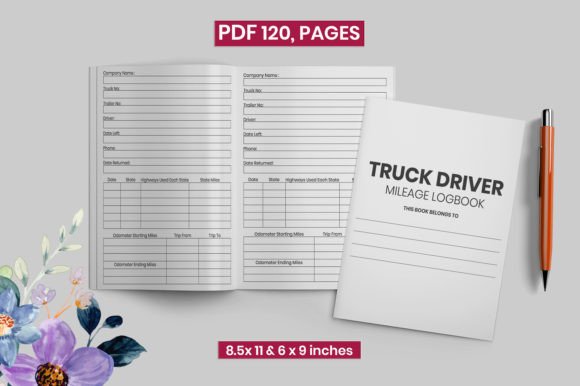
A typical high-quality mileage logbook interior includes dedicated spaces for recording the date, starting location, destination, purpose of the trip, odometer readings (start and end), total miles driven, and notes. Some logbooks also include sections for fuel purchases, tolls, parking fees, and other expenses. The best designs are intuitive, allowing you to complete an entry in under a minute while sitting in the driver’s seat.
For example, a logbook with dimensions of 6×9 inches or 8.5×11 inches offers enough space to write clearly without being bulky. The 6×9 size fits comfortably on a dashboard or in a glove compartment, while the 8.5×11 size provides larger entry fields for drivers who prefer more room. Both sizes are practical choices, depending on your personal preference and cab layout.
Key Features of a Well-Designed Mileage Logbook Interior
Let’s break down the specific components that make a logbook interior effective and user-friendly:
- Dedicated Entry Fields: Each page should have clearly labeled rows for date, trip purpose, start and end odometer readings, total miles, and any additional notes. This structure eliminates guesswork and ensures consistency.
- Ample Writing Space: A page count of around 120 pages is common for a logbook that can cover several months of daily driving. With 120 pages, you have room for roughly 4–6 months of entries, depending on how many trips you record each day.
- Bleed Margin: Professional print-ready interiors include bleed—an extra 0.125 inches around the edges—to ensure that no content is cut off during printing or trimming. This is a sign of quality design, especially for self-published or custom logbooks.
- High-Resolution Printing: A 300 DPI resolution ensures that text and lines are sharp, clear, and easy to read, even after months of use. This is particularly important if you plan to photocopy or scan pages for digital backup.
- Flexible Formats: Many modern logbook interiors are available as PDF or JPG files, making them suitable for both print-on-demand services like Amazon KDP and local printing. A high-quality PDF interior can be uploaded directly to KDP or taken to a print shop.
Practical Relevance: How a Mileage Logbook Fits into a Trucker’s Daily Life
Imagine you are a long-haul trucker running a route from Dallas to Los Angeles. You leave at 6:00 AM with a full tank, drive 1,200 miles over two days, deliver the load, and then return with a backhaul. Without a logbook, you might remember the total distance roughly, but you would lose the ability to separate business miles from personal miles, track fuel efficiency accurately, or prove your driving history if a question arises.
With a structured logbook, you simply record your starting odometer reading before you pull out of the yard. At the end of each day, you note the ending reading and the trip purpose. If you stop for a personal errand, you record those miles separately. At tax time, you have a clear, contemporaneous record that supports every deduction you claim.
Moreover, a logbook helps you monitor your vehicle’s health. By keeping a running record of odometer readings, you can anticipate oil changes, tire rotations, and other maintenance needs. This proactive approach reduces breakdowns and extends the life of your truck.
Clarifying Common Misunderstandings About Mileage Logbooks
One widespread misconception is that electronic logging devices (ELDs) have made paper logbooks obsolete. While ELDs are federally mandated for recording hours of service, they do not automatically track business mileage for tax purposes. An ELD records when the engine is running and how long you drive, but it does not capture trip purpose, personal versus business miles, or detailed expense information. A mileage logbook—whether paper or digital—remains essential for tax compliance and expense tracking.
Another misunderstanding is that you can reconstruct mileage at the end of the year from memory or credit card receipts. The IRS is explicit: you need contemporaneous records. A logbook filled out as you go is far more credible than a spreadsheet created in January for the previous year. Even a simple, well-designed paper logbook meets the standard of “adequate records.”
Finally, some drivers assume that only owner-operators need logbooks. In reality, any employee who uses a personal vehicle for business purposes—or who incurs unreimbursed business driving expenses—can benefit from a mileage log. For company drivers who occasionally use their personal trucks for business, a logbook is the only way to claim deductions legitimately.
How to Choose the Right Mileage Logbook for Your Needs
With so many options on the market, selecting the right logbook can feel overwhelming. Here are practical criteria to help you decide:
- Size Matters: A 6×9-inch logbook is portable and fits in most cab compartments. An 8.5×11-inch logbook offers larger entry fields and is easier to write in if you have limited dexterity or prefer more space.
- Page Count: Look for at least 100–120 pages to ensure the logbook lasts several months without needing replacement. This reduces the hassle of switching books mid-year.
- Print Quality: Choose a logbook with 300 DPI resolution and a bleed margin if you are ordering a print-on-demand version. These details indicate professional design and durability.
- Ease of Use: The layout should be intuitive. Avoid logbooks with overly complex columns or tiny fonts. You should be able to complete an entry in under a minute.
- Additional Features: Some logbooks include sections for fuel logs, maintenance records, expense tracking, and notes. These extras can turn your logbook into a comprehensive trip journal.
- Format Flexibility: If you prefer digital record-keeping, look for a logbook that comes as a printable PDF or JPG. This allows you to print only the pages you need or keep a digital backup.
Using a Mileage Logbook with Modern Technology
While paper logbooks remain popular, many truckers now combine them with digital tools. For instance, you can scan or photograph each completed logbook page and store it in a cloud service like Google Drive or Dropbox. This creates a backup that protects against loss, theft, or damage. Some drivers also use spreadsheet templates that mimic the logbook layout, allowing them to type entries on a tablet or laptop while still maintaining a paper backup.
If you are using a print-on-demand logbook from a platform like Amazon KDP, you can also order multiple copies at once—one for the cab, one for home, and one as a backup. The interior files are often tested for KDP compatibility, so you can be confident that the printed version matches the digital design exactly.
The Role of a Mileage Logbook in Tax Preparation and Audits
For truckers, the single most compelling reason to keep a meticulous logbook is tax savings. The IRS allows you to deduct either the actual expenses of operating your vehicle or a standard mileage rate. In 2025, the standard mileage rate for business use is projected to remain competitive, but you must be able to prove your business miles. A logbook is the primary evidence.
During an audit, the IRS will look for consistent, contemporaneous entries. A logbook that shows daily records—even if some entries are brief—is far more persuasive than a reconstructed summary. Your logbook should include:
- Date of each trip
- Starting and ending odometer readings
- Total miles driven
- Purpose of the trip (e.g., “delivery to ABC Warehouse,” “pickup at XYZ terminal”)
- Any personal mileage separated clearly
If you are ever audited, a well-maintained logbook can mean the difference between a smooth process and a costly penalty. It is your best defense.
Practical Tips for Maintaining Your Mileage Logbook
Consistency is the key to a useful logbook. Here are actionable strategies to build the habit:
- Keep it accessible: Store your logbook in a fixed spot in the cab—on the passenger seat, in a door pocket, or clipped to the visor. If it is easy to reach, you will use it.
- Record at the start and end of each driving day: Make it part of your routine. Before you start the engine, note the date and starting odometer. When you park for the night, record the ending reading and trip purpose.
- Use abbreviations consistently: To save time, create a personal shorthand for common destinations and purposes. Just ensure the abbreviations are clear enough for someone else (or an auditor) to understand.
- Review weekly: Every Sunday, flip through the past week’s entries to catch any gaps or errors. This habit keeps your records accurate and complete.
- Back up periodically: Take photos of completed pages or scan them into a digital folder. This protects your data if the physical logbook is lost or damaged.
Where to Find Quality Mileage Logbook Interiors
If you are considering self-publishing a logbook or printing a custom design for personal use, look for interior files that have been tested on platforms like Amazon KDP. A high-quality interior should include:
- 120 pages of entry space
- Both 6×9-inch and 8.5×11-inch size options
- 300 DPI resolution for crisp printing
- Bleed margins for professional trimming
- Formats: PDF and JPG
- A creative, unique design that is practical and visually clean
Many designers offer ready-to-upload interiors that save you hours of layout work. Whether you are printing a single copy for your own truck or producing a batch for sale, a tested interior file ensures quality and consistency.
Conclusion: Your Mileage Logbook Is More Than Just a Notebook
A mileage logbook is not merely a place to jot down numbers—it is a business tool, a legal safeguard, and a personal record of your professional journey. By choosing a logbook with a well-designed interior, committing to daily entries, and understanding the tax implications of your driving, you transform a simple notebook into a powerful asset. Whether you prefer the compact convenience of a 6×9-inch size or the spacious layout of 8.5×11 inches, the key is to start using it consistently today. Your future self—and your accountant—will thank you.
So, the next time you slide into the driver’s seat, take a moment to open your logbook. Record your miles, protect your deductions, and drive with confidence. The open road is yours, but the paperwork is part of the journey. Master it, and you master your business.